Most businesses treat traffic as the goal. They chase rankings, run ads, post on social media — and then watch visitors land on the site and leave without doing anything. If that sounds familiar, the problem usually isn’t traffic. It’s the website itself.
We’ve audited dozens of small and mid-sized business websites, and the same handful of issues show up again and again. Here’s what’s actually killing conversions — and what to do about each one.
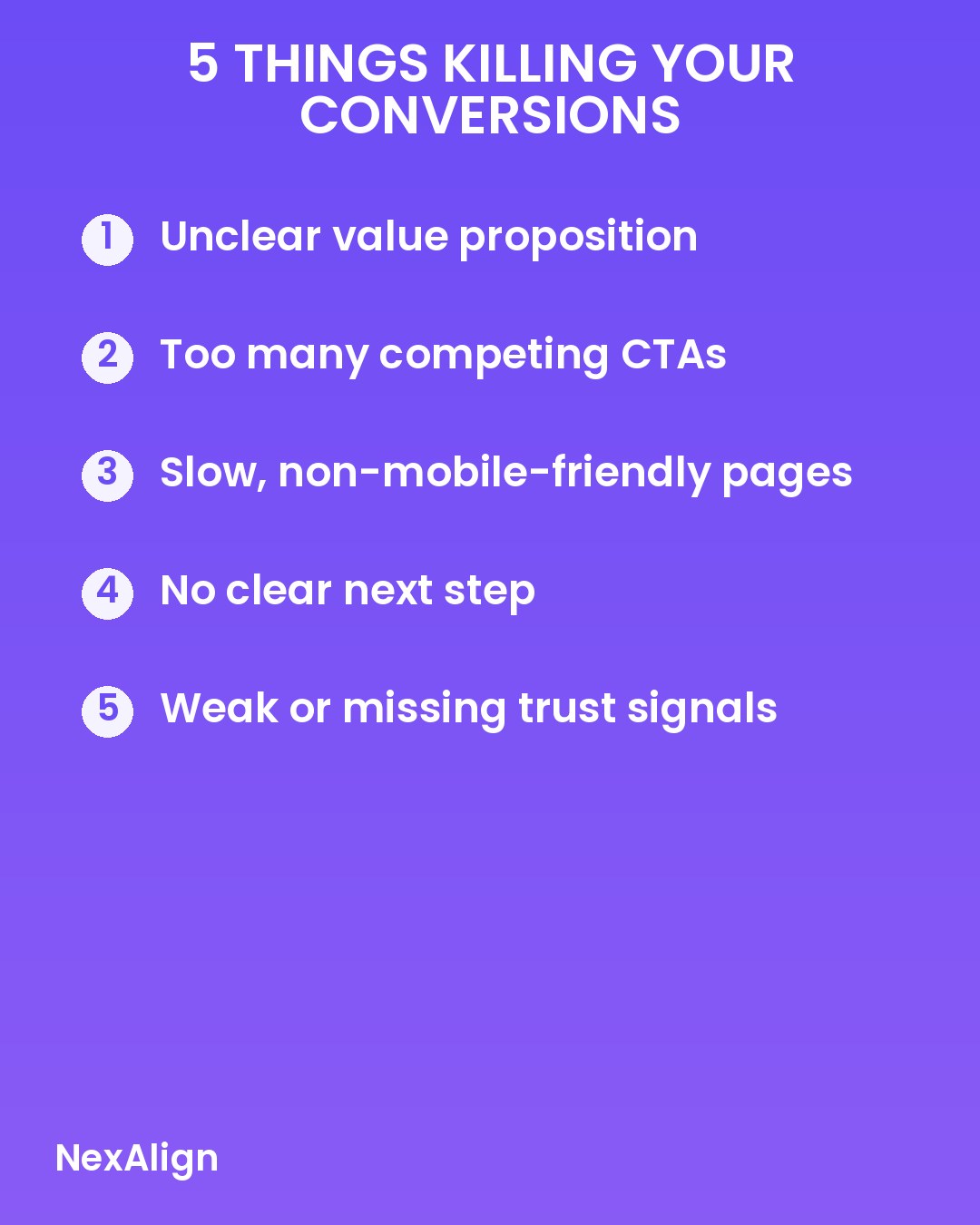
1. The value proposition isn’t clear in five seconds
Visitors decide whether to keep reading within the first few seconds on a page. If your homepage headline talks about your company history, your mission, or generic phrases like “innovative solutions for a changing world,” you’ve already lost them. A visitor should be able to answer three questions instantly: what do you do, who is it for, and why should they care. Everything else is secondary.
2. There are too many competing calls to action
A page with six different buttons — “Learn More,” “Contact Us,” “Download Brochure,” “Book a Call,” “Sign Up,” “View Pricing” — doesn’t give visitors more options, it gives them decision fatigue. Every additional choice reduces the odds that any single action gets taken. The fix is ruthless prioritization: pick one primary action per page and make it impossible to miss.
3. Page speed and mobile experience are an afterthought
Over half of web traffic is mobile, and conversion rates drop sharply for every extra second a page takes to load. Bloated images, unnecessary plugins, and desktop-first design choices are some of the most common (and most fixable) reasons a site underperforms. A fast, clean mobile experience isn’t a nice-to-have anymore — it’s the baseline.
4. There’s no clear next step
Even when a visitor is genuinely interested, plenty of sites fail to tell them what to do next. Forms are buried three clicks deep, contact information is hidden in a footer, or the only option is a generic “Contact Us” page with no context. Every page on your site should have an obvious, low-friction next step that matches how ready that visitor actually is to buy.
5. Trust signals are missing or weak
People don’t buy from businesses they don’t trust, and a website is often the first (and only) chance to build that trust before a conversation happens. Real client results, testimonials with names and companies attached, clear pricing or process information, and professional design all signal credibility. Stock photography, vague claims, and outdated design do the opposite.
How to actually fix this
Start with an honest audit. Look at your analytics: where do visitors drop off? Which pages have the highest bounce rates? Then prioritize fixes based on impact — usually that means fixing the homepage and your highest-traffic landing pages first, not a full redesign of every page at once. Small, tested changes (a clearer headline, a single strong CTA, faster load times) often move the needle more than a total rebuild. For a broader checklist of warning signs beyond these five, see 5 signs your business website is costing you customers. If you’d rather have this audited and fixed for you, our website build process starts with exactly this kind of review — or you can book a free strategy call to talk through your specific site.
Conversion isn’t about tricking people into clicking a button. It’s about removing every unnecessary obstacle between a genuinely interested visitor and the action they already want to take.
Frequently Asked Questions
Why isn’t my website converting even though I’m getting traffic?
Traffic and conversion are two separate problems. Getting visitors to your site solves discovery; getting them to act solves persuasion and usability. If people are showing up but not converting, the issue is almost always one of the five things above — usually an unclear value proposition or too many competing calls to action, not a lack of interest.
Why do my landing pages not convert?
Landing pages fail to convert most often because of message mismatch — the page doesn’t clearly continue the promise that got someone to click through — or because it offers too many options instead of one focused action. A good landing page has a single goal, a headline that matches what the visitor expected to find, and nothing distracting from the one thing you want them to do.
How do I fix a low-converting website without a full redesign?
You usually don’t need one. Start with the highest-traffic pages, tighten the headline so the value proposition is clear in five seconds, cut down to a single primary call to action, and check your mobile load time. These small, targeted changes typically move conversion rate more than a full rebuild, and they can be tested and shipped in days rather than months.
My small business website isn’t converting — what should I check first?
Check mobile load speed first — it’s the fastest thing to diagnose and it quietly kills conversions before a visitor even reads your headline. After that, look at whether your site has one clear next step (not six), and whether there’s any real trust signal — a review, a real client name, an actual phone number — visible without scrolling.
Want a second pair of eyes on your own site instead of guessing? Get a free audit and we’ll tell you exactly which of these is costing you the most.
Want a free audit of your own site?
We’ll check your speed, SEO, and conversion setup and send a personal breakdown — no cost, no obligation.